Wire sawing · beyond blade reach
Diamond Wire Saw Cutting in Miami
A diamond-beaded wire loop runs around the concrete and pulls through it under tension — so section size effectively stops mattering. Wire is how deep beams, heavy columns, pile caps, and machine bases get cut where no blade fits.
- No practical depth limit
- Cuts fully embedded steel
- Low vibration on sensitive structures
- Sections sized to crane or rigging limits
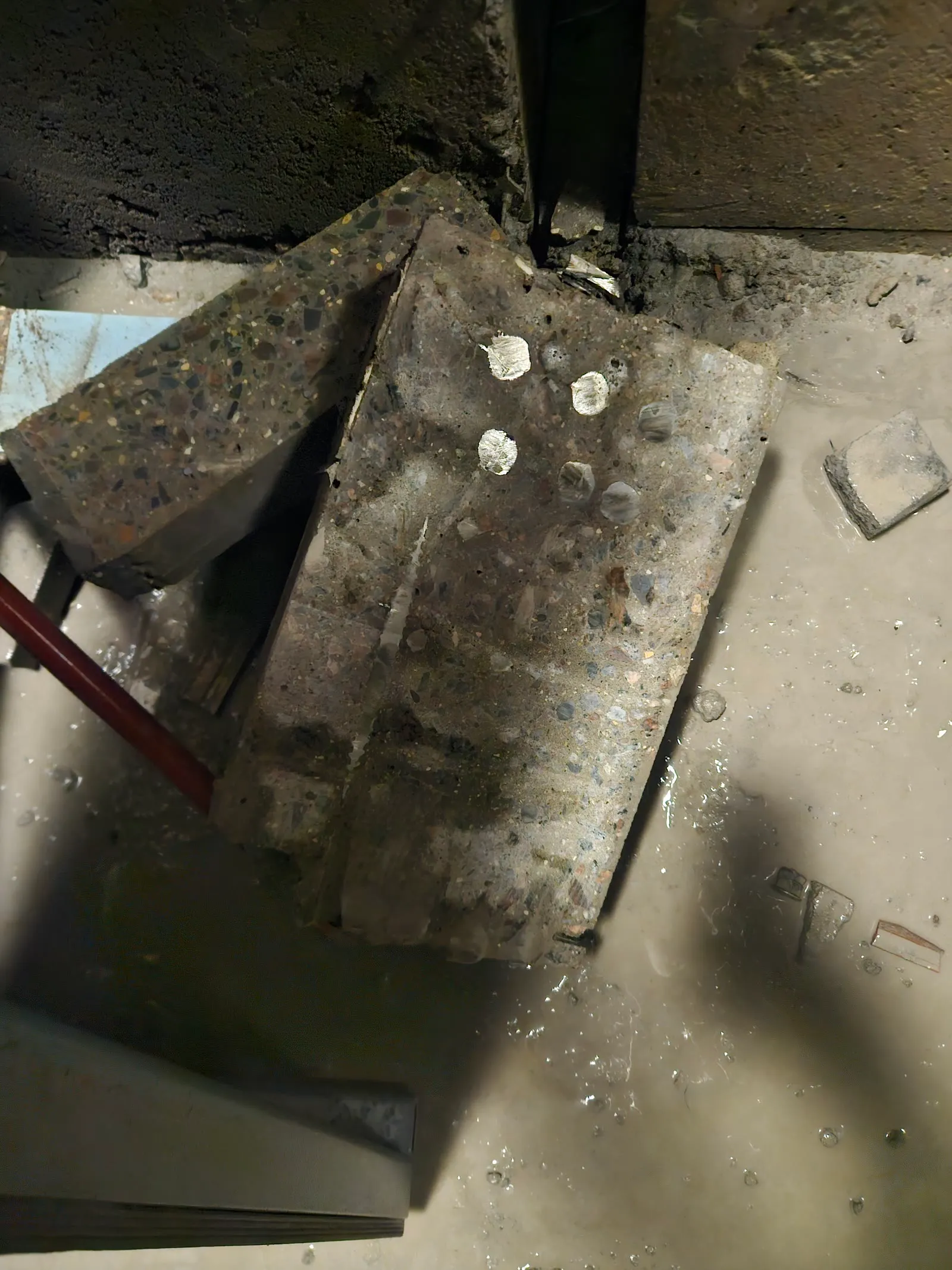
How wire sawing works
Small guide holes are core drilled through the element, the wire is threaded through and closed into a loop around it, and a drive unit spins the loop while pulleys keep it tensioned against the concrete. The wire abrades a narrow kerf straight through everything in its path — aggregate, rebar, embedded steel shapes. Because the cutting force is distributed along the wire rather than concentrated at a blade edge, the method is gentle on the surrounding structure.
Wire is not the first choice when a blade can reach — setup takes longer and costs more per cut. It is the only choice when the section is measured in feet, when access allows no saw geometry, or when a structure must come apart into large rigged pieces on a crane schedule.
Where wire sawing gets specified
Deep beams & transfer girders
Sections far beyond wall-saw depth, cut for structural modification or removal.
Columns & shear wall segments
Heavy vertical elements cut into pieces sized to the rigging plan during selective demolition.
Pile caps & foundations
Mass foundation concrete cut for underpinning, equipment pits, or partial removal.
Equipment bases & machine pads
Massive inertia blocks cut free and removed from operating plants without percussion.
Bridge & marine elements
Piers, caps, and segments where over-water or over-traffic work rules out breaking.
No-access geometries
Cuts flush behind obstructions, under water, or in shafts where no saw can be mounted.
Wire sawing working characteristics
| Section size | Effectively unlimited — the wire loop scales to the element |
|---|---|
| Kerf | Roughly 0.4 – 0.5 in — minimal material loss on precision cuts |
| Steel content | Cuts heavy rebar, embedded shapes, and composite sections |
| Water | Wet process; flush water and slurry managed like other diamond cutting |
| Setup | Guide cores + pulley rigging; more setup than blade work, justified by section size |
| Sequencing | Cut plan coordinated with shoring and crane picks by the engineer of record |
What helps price wire sawing
- Element dimensions — the cut’s cross-sectional area drives everything
- Drawings or sections of the element, including known embedded steel
- The removal plan: crane capacity, pick weights, and access for rigging
- Shoring/bracing design status — engineered removal sequence required for structural elements
- Water supply and slurry handling constraints on site
- Schedule interfaces: road closures, plant shutdowns, tide/marine windows
Frequently asked questions
When is wire sawing worth it over a big blade?
Past roughly 30 in of required depth, when access geometry defeats a track saw, or when the piece must come out whole for rigging. Below that, wall sawing or slab sawing is faster and cheaper.
How accurate is a wire cut?
Guide pulleys hold the wire on plane, so cuts track straight through very large sections — accurate enough for structural modification faces that get built against.
Can wire sawing run without shutting the building down?
Often yes — it is quiet relative to any percussion method and transmits little vibration. The governing constraints are usually rigging logistics and the engineer’s shoring sequence rather than noise.
Who engineers the removal sequence?
The project’s engineer of record — cut-and-pick sequencing on structural elements is an engineered deliverable. Operators execute the sequence and coordinate with the crane crew; they do not design it.
Project intake
Scope a wire sawing cut
Element dimensions, drawings, and the removal concept. Independent operators with wire capability review and price the work.