Concrete coring · Miami-Dade & South Florida
Core Drilling in Miami
Diamond core bits cut clean, round, dimensionally exact holes through reinforced concrete — slabs, walls, beams, columns, and foundations — without the impact damage of a rotary hammer. Send your penetration schedule and get scope-based pricing.
- Diameters 1/2 in to 14 in+ standard
- Cuts straight through rebar
- Wet drilling with slurry control
- Vertical, horizontal & angled cores
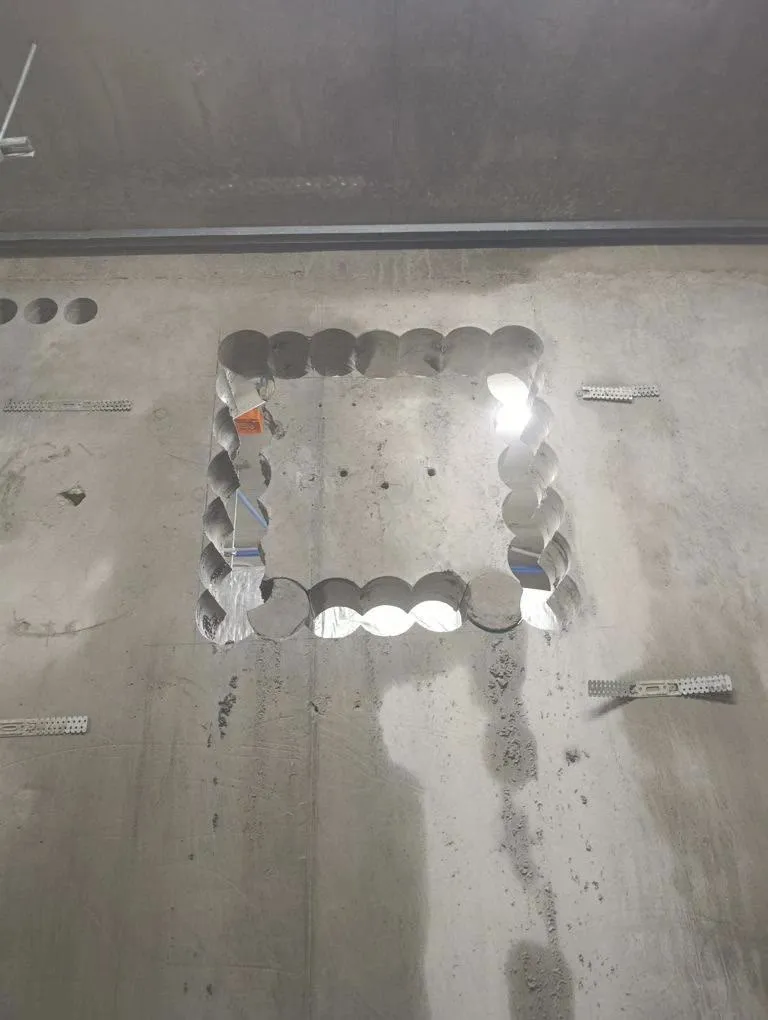
What core drilling is — and when it beats every alternative
Core drilling uses a rotating diamond-segmented steel barrel, cooled and flushed with water, to remove a solid cylinder of concrete. The result is a smooth, precisely located hole with no spalling on either face and no micro-cracking around the opening — which is why it is the standard method for penetrations through structural concrete.
Rotary hammers and demolition breakers make oversized, ragged openings, transmit vibration into the structure, and stall the moment they meet rebar. A core bit cuts steel and aggregate together at the same rate. When the hole has to land where the drawings say — through a heavily reinforced beam, an occupied condo slab, or a post-tension deck — coring is the method estimators will price.
What gets core drilled on Miami jobsites
Most core drilling in South Florida is MEP-driven: new penetrations through existing structure during renovation, tenant build-out, and system upgrades.
Plumbing penetrations
Drain, waste, and vent stacks, water risers, and sleeve penetrations through slabs and walls — typically 2 in to 8 in cores.
HVAC penetrations
Refrigerant linesets, condensate lines, round duct, ventilation, and dryer/exhaust terminations through slabs and exterior walls.
Electrical & conduit
Conduit banks, feeder routes, data/comm pathways, and floor box penetrations — often drilled in tight clusters.
Sleeves & firestopping
Oversized cores for pipe sleeves so trades can set, insulate, and firestop penetrations to the project spec.
Anchoring & dowels
Holes for anchor bolts, dowel bars, railing posts, and equipment mounts where epoxy embedment needs an exact diameter.
Test cores & sampling
Extracted cylinders for compressive-strength testing or condition assessment, taken where the engineer marks them.
Typical working ranges
Exact capabilities vary by rig and operator; these are the ranges commercial estimators generally price without special mobilization.
| Hole diameter | 1/2 in – 14 in standard; larger diameters and overlapping (stitch) cores for bigger openings |
|---|---|
| Depth per setup | Up to about 14 in with a standard barrel; barrel extensions take single holes several feet deep |
| Orientation | Vertical (down or overhead), horizontal, and angled cores off a rig anchored or vacuum-mounted to the structure |
| Materials | Reinforced concrete, post-tension slabs (after locating tendons), CMU/masonry, brick, stone, asphalt |
| Method | Wet drilling is standard; dry or vacuum-assisted drilling where water is prohibited — see wet vs dry below |
| Power | Electric rigs for interior/occupied space; hydraulic or high-frequency heads for large diameters |
Reinforced concrete, post-tension slabs, and scanning
Cutting rebar mid-hole is routine. Cutting a live post-tension tendon is not — it can be dangerous and expensive to repair. Much of Miami's high-rise inventory is post-tensioned, so on elevated decks the working assumption is PT until drawings prove otherwise. GPR scanning before drilling locates tendons, rebar, and embedded conduit so cores can be shifted an inch instead of becoming a change order.
If scanning is already done, note it in your request and include the marked-up layout. If not, request it as a line item — see the guide on core drilling post-tension slabs for how the workflow changes.
How a core drilling request works
-
Send the scope
Quantity, diameters, slab or wall thickness, floor level, and — ideally — the penetration schedule or a marked-up plan. Photos of the work area help with access questions.
-
An independent provider reviews and prices it
Your request is reviewed by an independent Miami-area operator who confirms method, scanning needs, water handling, and schedule, then issues their own estimate.
-
Confirm logistics
Layout responsibility, power and water availability, containment expectations, night or day work window, and building or GC requirements get locked down before mobilization.
-
Drilling day
The rig is anchored or vacuum-mounted, holes are drilled to layout, slurry is contained and removed, and cores are hauled off or left palletized — whatever the jobsite requires.
Water, slurry, and dust control
Wet coring produces slurry — a fine cement paste that stains finishes and is never allowed down a storm drain. On occupied floors, crews typically build containment with slurry rings, wet vacuums, and plastic sheeting below the deck when a core will daylight into the space beneath. Where water is prohibited entirely — data rooms, finished retail, some electrical rooms — dry drilling with HEPA vacuum extraction is the fallback, with trade-offs in speed and bit life.
Good requests say up front whether the floor below is occupied and whether water is available on site. The slurry control guide covers what containment looks like in practice.
What helps price core drilling accurately
You can skip anything you don’t know — but each of these tightens the number:
- Quantity and diameters — e.g. "12 holes at 4 in, 3 holes at 8 in"
- Element and thickness — 8 in elevated slab vs 24 in foundation wall are different jobs
- Material — reinforced concrete, post-tension, or CMU
- GPR status — already scanned, needed, or not sure
- Access — floor level, elevator size, distance from parking, overhead clearance
- Utilities — is water and 120/240V power available at the work area?
- Work window — business hours, nights, or weekend, and any building noise rules
- Files — penetration schedule, structural drawings, or photos of the area
Frequently asked questions
Can you core drill through rebar?
Yes — diamond core bits cut rebar and aggregate together, and hitting steel mid-hole is normal. What changes the plan is post-tension tendons and embedded conduit, which is why elevated decks usually get GPR scanned before drilling.
What diameters and depths are available?
Common commercial work runs 1/2 in through 14 in diameter. Larger single-bit diameters are available by request, and bigger round or rectangular openings are made by stitch drilling overlapping cores or by wall sawing. Barrel extensions take single holes several feet deep.
Is core drilling loud? Can it happen in an occupied building?
Coring is rotary, not percussive, so it is dramatically quieter than a demolition hammer and transmits far less vibration. Occupied offices, condos, and hospitals are routine settings — often on a night work window with containment below the deck.
Do I need GPR scanning before drilling?
On elevated slabs in South Florida, treat it as a default — much of the local inventory is post-tensioned. On slab-on-grade with drawings in hand it is more of a judgment call. The GPR guide covers when it is worth the line item.
How is core drilling priced?
Typically per hole, scaled by diameter and depth, on top of a mobilization minimum. Access, scanning, night work, and slurry handling move the number. The core drilling cost guide breaks down the drivers — or send your scope for a real number.
Can holes be drilled horizontally or at an angle?
Yes. Rigs anchor or vacuum-mount to walls and soffits for horizontal and overhead work, and can be set to drill at a specified angle — common for sleeves through foundation walls and slope-critical drain lines.
Project intake
Price your core drilling scope
Hole count, diameters, thickness, and floor level — plus your penetration schedule if you have one. Independent Miami-area providers review and price the actual work.