Flat sawing · floors, decks & pavement
Concrete Slab Sawing in Miami
Slab saws (flat saws) run a diamond blade through horizontal concrete from above — the workhorse method for trench runs, slab removal sections, and clean joints in floors, decks, and pavement.
- Cut depths commonly to ~12 in
- Electric saws for occupied interiors
- Trenches for plumbing & conduit
- Sections sized for removal crews
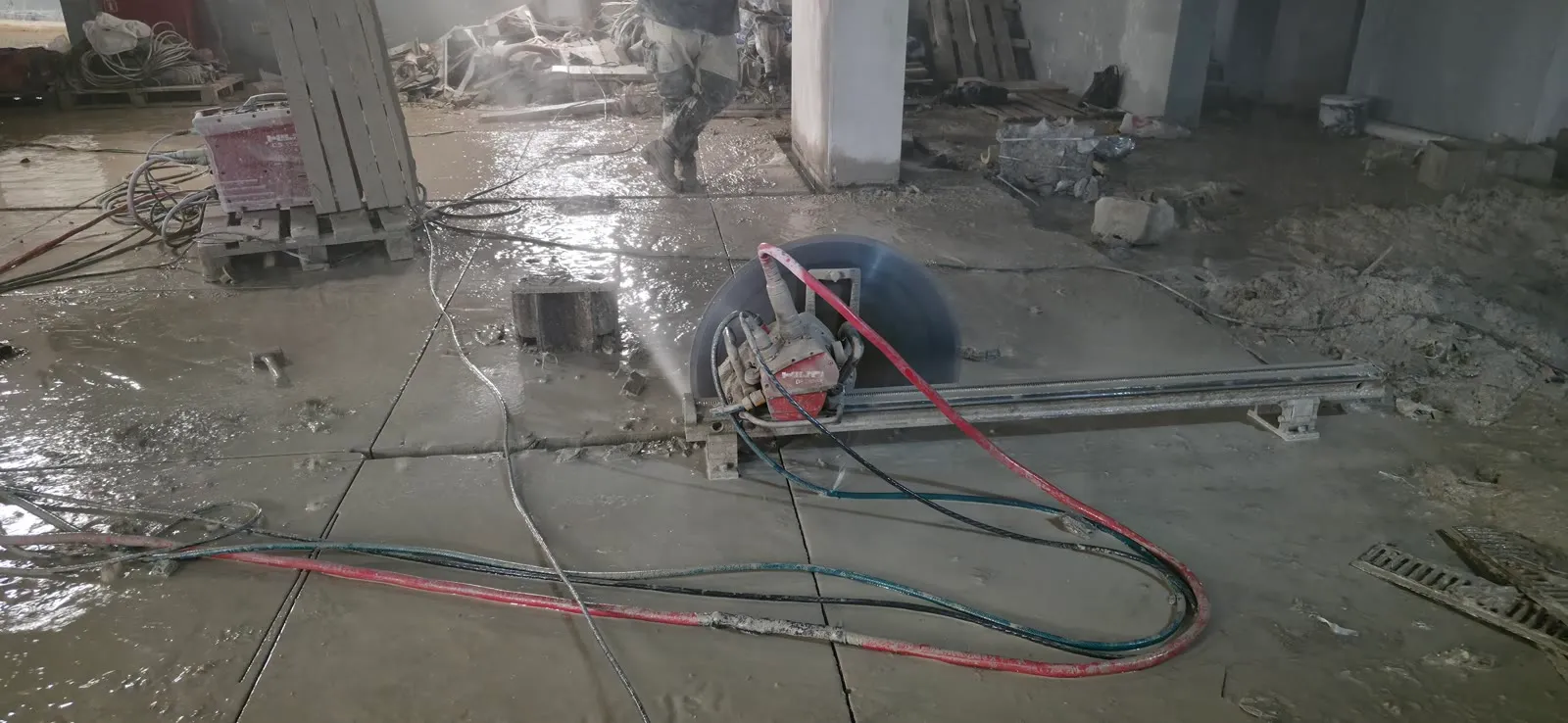
Where slab sawing earns its keep
Any time a floor has to open — a new drain line across a restaurant, a conduit route through a warehouse slab, a bay of damaged concrete coming out — the slab saw defines the edges first. A saw-cut edge is straight, vertical, and undamaged, so the pour-back bonds properly and the patch does not telegraph. Breaking without cutting first leaves feathered, cracked edges that fail early.
Interior work uses electric saws with wet cutting and slurry vacuuming; exterior and pavement work runs bigger diesel saws. On elevated decks, cut depth and loading get checked against the structure — and PT decks get scanned before any full-depth cut, exactly as with coring.
Typical slab sawing scopes
Plumbing trenches
Parallel cuts for new drain and water lines in slab-on-grade — the standard prep for restaurant and tenant plumbing re-work.
Electrical & EV conduit runs
Narrow trench cuts across garages and warehouse floors for conduit banks, paired with coring where the run turns vertical.
Slab removal sections
Damaged or demo-scoped slab cut into liftable panels for break-out and haul-off.
Expansion & control joints
New joints, joint widening, and crack-chasing in industrial floors.
Deck & balcony repairs
Delaminated deck sections cut to sound concrete on restoration projects — a constant in South Florida’s salt-air inventory.
Pavement & site work
Roadway, sidewalk, and curb cuts for utility crossings and ADA modifications.
Slab sawing working ranges
| Cut depth | Commonly to ~12 in; deeper (to ~24 in+) with large-diameter blades and staged passes |
|---|---|
| Blade sizes | 14 – 60 in diameter, matched to depth and machine |
| Power | Electric (interior, zero exhaust) or diesel (exterior, high production) |
| Materials | Reinforced slabs, post-tension decks (after scanning), plain concrete, asphalt |
| Trench widths | Any width — two parallel cuts define it; spoil broken out between |
| Finish | Straight vertical edges ready for dowels, pour-back, or joint filler |
What helps price slab sawing
- Total linear feet of cut and the layout (a sketch or marked plan is perfect)
- Slab thickness — measured, from drawings, or “unknown” and verified on site
- On grade or elevated deck? PT decks change the workflow
- Interior or exterior; occupied or clear space
- Who breaks out and hauls the spoil — the saw crew or your own labor
- Water source on site, and where slurry can be staged for disposal
Frequently asked questions
How deep can a slab saw cut?
Standard machines handle the common 4–8 in slabs easily and reach ~12 in routinely; large blades extend past 24 in. Depth beyond blade reach — thick foundations, deep beams — moves the scope to wire sawing.
Will cutting damage rebar or wire mesh in the slab?
The blade cuts through mesh and rebar as designed — that is normal for removal scopes. Where dowels must be preserved or the engineer restricts cutting depth over reinforcement, the cut plan reflects it.
Can floors be cut inside an operating business?
Yes — electric saws, wet cutting, vacuum slurry recovery, and off-hours windows make interior work routine. Expect containment and a night schedule for retail and restaurant floors.
Do you also remove the concrete between cuts?
Break-out and haul-off can be included or excluded — it is one of the biggest swings in a floor-cutting price, so the request form asks directly. See selective demolition for full removal scopes.
Project intake
Price your floor cuts
Linear feet, slab thickness, and a marked-up plan — that’s enough for an independent Miami-area operator to price trenching or removal cuts.